

Would I Be the Same Person If I Had Grown Up Somewhere Else?

I have wondered about this question before, but I don't think I ever really stopped to think about what it means.
If I had grown up somewhere completely different, would I still have the same personality?
Would I have the same sense of humor, the same habits, the same opinions? Would I still be the person I am now, or would I be almost unrecognizable to myself?
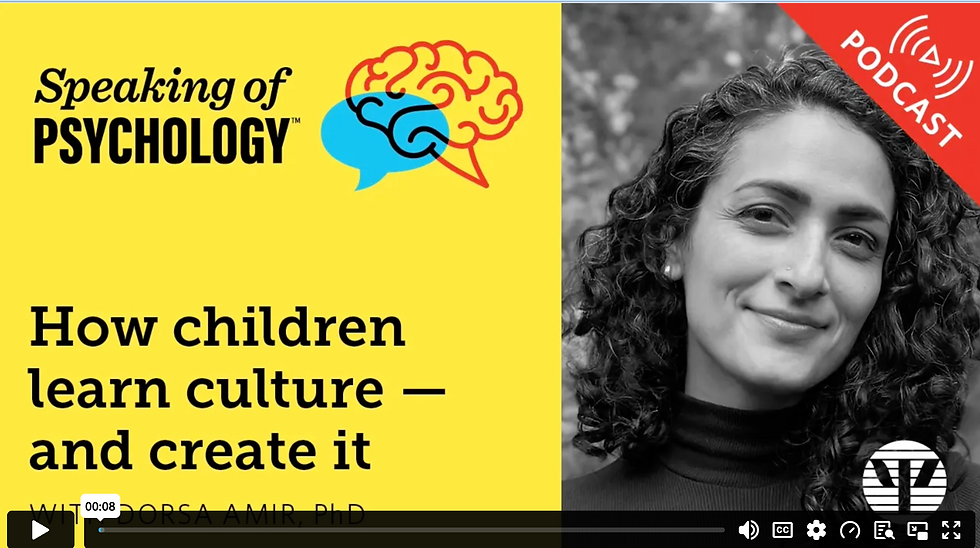
Recently, I listened to an episode of the American Psychological Association's Speaking of Psychology podcast with Dr. Dorsa Amir, a psychologist and researcher who studies the relationship between culture and the mind. The episode is called How Children Learn Culture—and Create It, and it explores a question that I found surprisingly difficult to answer: how much of the way we think is universal, and how much is shaped by the culture we grow up in? (source: APA)
I think I have always assumed that there is a fairly clear line between who we are and where we come from.
There is me, and then there is my environment.
But the more I thought about the podcast, the less convincing that separation became.
We often talk about personality as if it is something that belongs entirely to us. Someone is naturally confident. Someone else is naturally shy. Someone is independent, competitive, generous, cautious or outspoken.
But how much of what we call personality is actually influenced by what we have been taught to value?
Think about something as simple as what it means to be polite.
In some families, interrupting an adult is considered extremely disrespectful. In others, children are encouraged to express their opinions and ask questions. In some cultures, making direct eye contact can be associated with confidence. In others, it can be interpreted differently depending on who you are speaking to.
Neither one is necessarily the universal way of behaving.
We learn these things.
For example, in my own experience, I learned that you don't wear a hat at the table, and at home we always have dinner at the table without television or distractions, using that time to talk and share our day.
That was one of the ideas I found most interesting in Amir's work. She describes culture as something we learn from other people, and her research looks at how cultural environments can shape the way people think, behave and interact. She has also worked with the Shuar, an Indigenous community in the Ecuadorian Amazon, comparing aspects of childhood and development across very different cultural environments. (APA)
The differences can be surprisingly basic.
For example, Amir discusses research looking at children's preferences for risk and cooperation. Some behaviors that might seem like natural parts of development can actually be influenced by the environment children grow up in. In one example, Shuar children living in communities more closely connected to cities showed patterns that were more similar to American children than Shuar children living in more traditional communities.
That made me think about how easily we can mistake something that is familiar to us for something that is universal.
If everyone around me behaves a certain way, it is very easy to assume that this is simply how people behave.
But maybe it is just how we behave.
And I think that is one of the most interesting things about growing up around different cultures. You start to notice things that you probably would not question if you had only experienced one environment.
You realize that there are many ways to have a family, many ways to communicate, many ideas about childhood, success, independence and responsibility.
Even the things we think of as obvious can be cultural.
The podcast also made me think about childhood in a different way.
When we talk about children learning culture, it is easy to imagine children as empty containers. Adults know things, children don't, so adults teach them how the world works and children absorb the information.
But that isn't really what happens.
Children don't just receive culture.
They create it too.
One of the ideas Amir discusses is peer culture: the culture that children create among themselves. Think about playground games, inside jokes, slang, rules that only make sense to a particular group of friends, or some completely random game that becomes a tradition among a group of kids.
Adults didn't necessarily invent any of that.
Children did.
And they pass it on to other children.
This made me think about how much of growing up happens outside of the things adults deliberately teach us. We learn from parents and teachers, obviously, but we also learn from friends, classmates, siblings and the people we spend time with.
Sometimes those lessons may actually be more influential because we don't think of them as lessons.
No one sits you down and explains the rules of friendship.
You figure them out.
You notice what makes someone popular, what makes someone trustworthy, what gets laughed at, what gets you included and what makes you stand out.
And those experiences become part of how you understand other people.
So I came back to my original question.
Would I be the same person if I had grown up somewhere else?
Probably not.
But I don't think the answer is that culture completely determines who we are either.
That would be too simple.
What I found interesting about Amir's research is that children aren't just passive recipients of their culture. They learn from their environment, but they also interact with it, adapt to it and create new things within it. Her research on peer cultures takes this idea even further, suggesting that children's interactions with one another may actually play an important role in how culture itself changes over time.
Maybe identity works in a similar way.
We are shaped by the places and people around us, but we are not simply the product of them.
We take some things with us. We reject others. We change things without even realizing it. We combine different influences and eventually pass some of them on to someone else.
That is what makes the original question so difficult.
If I had grown up somewhere else, I would probably have different habits, different assumptions and maybe even a different idea of who I am.
But I would still be the person interpreting that environment.
And maybe that is where the balance between culture and individuality comes in.
We don't choose the environment we are born into. We don't choose our first language, our family, the customs we grow up around or many of the assumptions we initially learn about the world.
But as we get older, we start noticing those things.
We can question them.
We can keep some and let others go.
We can encounter another way of doing something and realize that the way we thought was “normal” was actually just one possibility among many.
Maybe that is one of the reasons I find culture so interesting.
The more you learn about it, the harder it becomes to separate what is you from what you have learned from everyone around you.
And honestly, I don't think that is a bad thing.
It makes identity feel less like something fixed and more like something that develops through an ongoing conversation between us and the world around us.
So, would I be the same person if I had grown up somewhere else?
I don't think so.
But I also don't think I would be a completely different person.
Maybe I would just be a different version of the same question.
Sources:
Dorsa Amir, PhD, How Children Learn Culture—and Create It, Speaking of Psychology, American Psychological Association, Episode 382, June 3, 2026.

Comments